
If your baby's skin turns dry or blotchy after baths, someone has probably told you it's the chlorine. Someone else has said hard water. A third person swears filtered water fixed everything for their kid, and a fourth says the whole thing is marketing.
The actual research is more interesting than any of those answers. It's also more specific, and since we sell a bath filter, we think we owe you the specifics rather than the sales pitch. Here's what the studies say, including the parts that don't help us.
The study that started the conversation: 1,303 babies in hard-water homes
In 2016, researchers at King's College London examined 1,303 three-month-old infants across England and Wales, matched each home to its water supplier's data, and checked the babies for eczema. Infants in hard-water areas had up to 87% higher odds of visible eczema than those in soft-water areas. That's the headline finding, and it's held up as a genuine signal: a 2021 meta-analysis pooling seven studies and 385,901 participants found children in hard-water areas had about 28% higher odds of eczema overall.
Two honest footnotes belong next to that. The researchers grade the pooled evidence as low-certainty, meaning the association is consistent but nobody has proven cause and effect yet. And when the same team piloted the obvious fix, installing water softeners in the homes of newborns (the SOFTER trial, published 2021), the trial was designed to test feasibility, not efficacy. Fewer softener babies developed eczema (33% versus 48%), but the sample was too small for that difference to be conclusive. The definitive trial hasn't been published yet.
The senior author, dermatologist Dr. Carsten Flohr, put it this way: "Our study builds on growing evidence of a link between exposure to hard water and the risk of developing eczema in childhood. It's not yet clear whether calcium carbonate has a direct detrimental effect on the skin barrier, or whether other environmental factors directly related to water hardness may be responsible."
How hard water bothers skin: it's the soap that stays behind
A 2018 study from the Universities of Sheffield and King's College London worked out a mechanism, and it's not what most people assume. Hard water doesn't attack skin directly. It makes soap harder to rinse off. When 80 adults washed with a standard cleanser in hard versus soft water, the hard-water washes left significantly more surfactant residue on the skin, and that residue raised water loss through the skin and caused irritation. The effect was worst in people with eczema-related gene mutations.
That finding hands parents a lever that costs nothing: use less cleanser than you think you need, choose a mild fragrance-free one, and rinse well. The American Academy of Pediatrics says the same thing for different reasons: soap sparingly, three baths a week is enough for most of the first year, and more frequent bathing dries skin out on its own.
Now chlorine, honestly
Here's where a filter company is supposed to tell you chlorine causes eczema. It doesn't, as far as anyone has shown. In the King's College study, the high-chlorine, soft-water group was the one group that didn't reach statistical significance. The 2018 mechanism study said it flatly: "a clear effect of chlorine was not observed." And dermatologists deliberately prescribe dilute bleach baths, which are far more chlorinated than tap water, as a treatment for moderate-to-severe eczema, because at that concentration the antimicrobial benefit outweighs the irritation.
What chlorine does do is dry skin, and the evidence for that sits at concentrations found in regular tap water. A Japanese study immersed forearms in water at increasing chlorine levels and measured the skin's water-holding capacity. In people with eczema-prone skin, it dropped significantly at 0.5 milligrams per liter. US utilities are required to keep a minimum residual of about 0.2 mg/L in the pipes and are allowed up to 4.0, so everyday bath water sits inside the range where that drying effect showed up. It was a small study (30 adults, one clinic, 2003), so hold it loosely, but it's the cleanest dose-response data anyone has collected.
The fair summary: chlorine is a drying irritant for sensitive skin at normal tap concentrations, and eczema itself is driven by genetics and immune biology, with water chemistry as one modifiable factor among several. Anyone telling you a filter will prevent or cure eczema is ahead of the evidence.
Why babies get the worst of it
Infant skin really is different, and the differences are measured, not marketing:
- The stratum corneum, the outer barrier layer, is about 30% thinner than an adult's, and the epidermis about 20% thinner.
- Through the whole first year, infant skin loses and absorbs water faster than adult skin and carries less natural moisturizing factor. Its water handling only becomes adult-like after roughly twelve months.
- A baby's skin surface area relative to body weight runs several times an adult's, so the same exposure delivers a proportionally bigger dose per pound. (You'll often see this quoted as "baby skin absorbs five times more," which garbles it: a healthy full-term baby's skin barrier is competent. It's the dose-to-body-size ratio that's outsized, not the skin's leakiness.)
Thinner barrier, faster moisture loss, bigger relative dose: that's why the same bath water can leave a toddler's skin unbothered and a three-month-old's dry and red.
What a bath filter can and can't do about any of this
Time for the disclosure a lot of brands in our category skip.
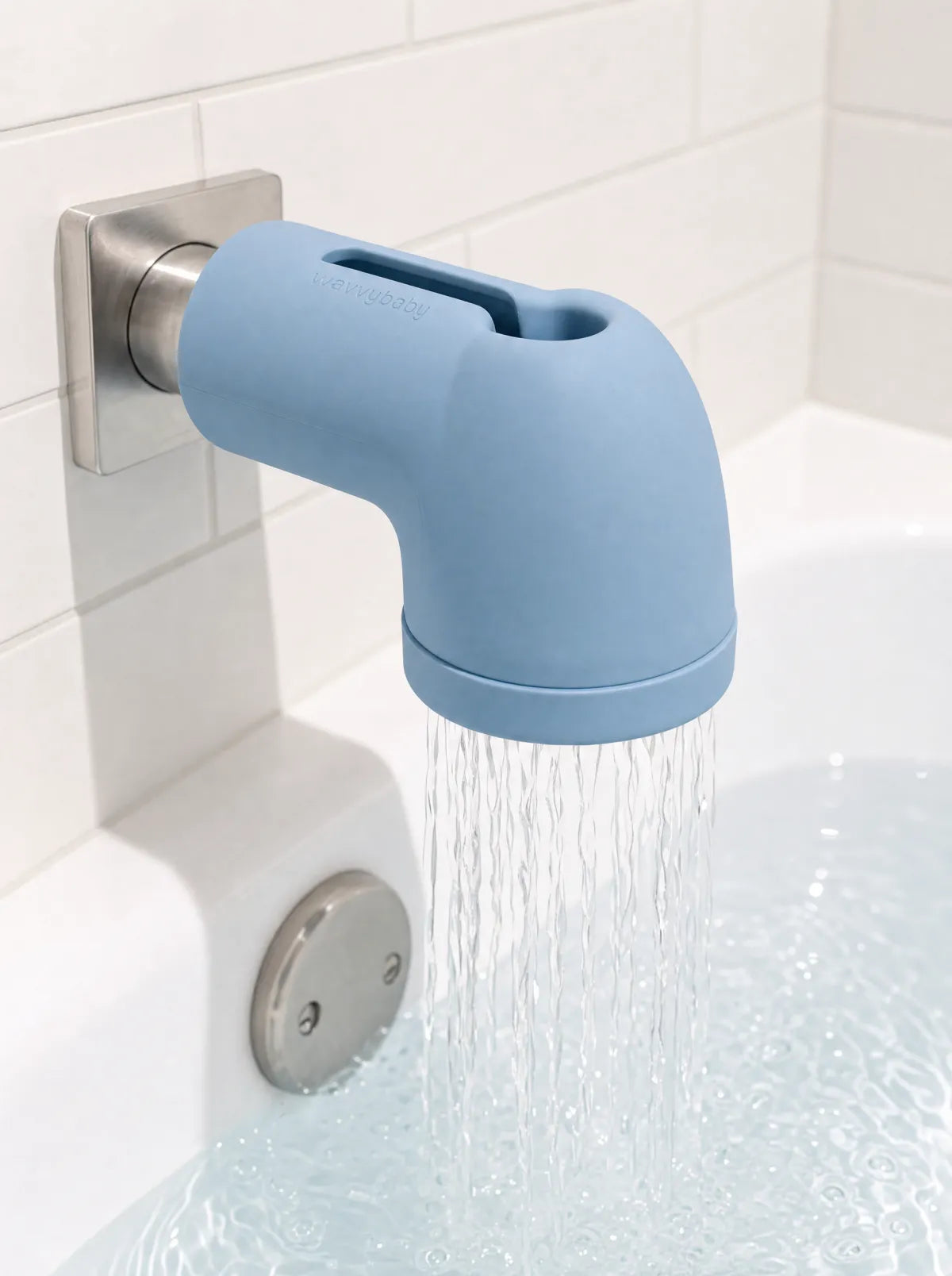
What a spout filter can do: reduce free chlorine, which is the drying irritant above. The standard media stack (activated carbon, calcium sulfite, copper-zinc alloy) is genuinely good at this job when water gets enough contact time; calcium sulfite in particular keeps working in warm water, where carbon fades. Filters also catch sediment and rust, and copper-zinc media targets some heavy metals.
What no spout filter can do: soften water. Hardness is dissolved calcium and magnesium, and removing it takes an ion-exchange softener or reverse osmosis at the house level. Read that against everything above and you'll see why we lead with honesty: the single strongest strand of eczema evidence concerns hardness, which a bath filter cannot touch. The variable a filter does address, chlorine, has the more modest evidence: a real drying effect on sensitive skin, not a causal role in eczema.
Also worth knowing: chloramine, the disinfectant used for more than one in five Americans (chosen by utilities partly because it forms fewer regulated byproducts than chlorine), resists standard filter media at bath flow rates. And no bath filter removes disinfection byproducts already formed at the treatment plant. If a brand claims either, ask for the lab report.

What we'd actually do, in evidence order
If your baby's skin runs dry or eczema-prone, this is the sequence the research supports, cheapest lever first:
- Bathe less, shorter, cooler. Around three baths a week for the first year (AAP), five to ten minutes in lukewarm water (AAD's guidance for eczema-prone kids). Test the water on the inside of your wrist; it should feel warm, not hot.
- Use barely any cleanser, and rinse well. The hard-water mechanism runs through soap residue, so less soap means less residue. Mild, fragrance-free, neutral pH.
- Moisturize within three minutes of the bath. The AAD's "soak and seal" advice. Thick creams and ointments beat lotions. This is the highest-evidence habit on the list.
- Know your water. Hardness, disinfectant type, and levels vary block by block. Our free ZIP-code report shows what your utility delivers, sourced from EPA and EWG data. (One framing note: EWG is an advocacy group whose health guidelines are deliberately stricter than federal legal limits. "Exceeds an EWG guideline" means stricter-than-law scrutiny, not that your water is illegal or acutely unsafe.)
- Filter the chlorine if it bothers your baby's skin. This is where WavvyBaby fits: reducing the drying irritant in every bath, for the cost of a refill cartridge every ninety baths. A useful lever, honestly sized.
- For diagnosed eczema, work with your pediatrician. Prescription treatment, and bleach baths where recommended for moderate-to-severe cases, have stronger evidence than any water intervention.